Hey, hey, hey—I’m back with a new episode in our “What’s Working Now” series, and today we’re diving into one of my favorite topics: blogging. If you’ve been around for a while, you already know how passionate I am about blogging (like, I could talk about it for hours). So let’s get into it!
If you’re new here, this series is all about what’s actually working right now—in 2025. A few episodes back (I think it was episode 62), I covered Pinterest, and that episode was 52 minutes long. You all listened to an average of 42% of it, which is amazing (lol). If you made it all the way through—thank you! I’m going to try and keep this one a little shorter, but we’ve got a lot to cover.
In this episode, I’m breaking down:
- Why blogging still matters in 2025
- Outdated blogging advice you need to ditch
- What actually matters when it comes to keywords
- What Google wants now
- How to make sure your traffic is leading to actual sales
- What a bare-minimum blogging strategy looks like
- And how to repurpose your blog content effectively
Oh—and make sure you stick around ‘til the end because I’ll be answering some frequently asked questions, and there are some really good ones in there.
Let’s dive in!
Listen on Apple | Listen on Spotify
Table of Contents
I want to share what actually prompted this episode—though let’s be honest, it’s part of a series, so I already knew a blogging episode was coming. But recently, I was in a mastermind where we were practicing our elevator pitches. I introduced myself by saying, “I’m Kara, and I help online business owners and service providers get found online through search-driven marketing strategies like podcasts, Pinterest, and blogging.”
Everyone was hyping me up, and one person made a comment that stuck with me: “I’m so glad you said ‘search-driven’—because we all know SEO is kind of over.”
And I was like…oh wait. No. I don’t agree with that at all. I’m glad they liked my elevator pitch, but let’s set the record straight—SEO is not dead. I really wish people would stop saying that, because it’s just not true.
Yes, the landscape is shifting. AI, new platforms, and changing search behavior (like people heading to YouTube or TikTok first) are definitely factors. But SEO is still one of the most powerful ways to drive organic traffic to your website—and blogging plays a massive role in that.
Quick side story: one of my clients recently asked me, “Hey, we’re doing blogs, but should I also hire you for SEO copywriting?” And honestly, after looking at their site, I told them the backend and their current copy were already well-optimized. If they wanted a full rewrite for better messaging, sure, I’d be all in. But for SEO alone? They were fine. What they really needed was more content—and more time.

Why You Should Be Blogging For Your Small Business
That’s where blogging comes in. Blogging helps move the needle faster. Evergreen blog content and search-driven marketing can keep generating leads for years—unlike short-form content that disappears in 24 hours.
Another quick example: I recently bought a house, and while searching for design ideas on TikTok, I was getting shown videos from 2022 and 2023. That’s what makes blogging so powerful. Your content keeps working for you. And as a small business, that’s gold. We don’t always have time or budget for flashy campaigns, so investing in content that compounds over time is such a win.
Plus, blogs are the foundation of your whole content ecosystem. You can repurpose them in so many ways (which I’ll talk about later in this episode). And even if SEO disappeared tomorrow—which it won’t—blogging would still be worth it.
You don’t need a blog to become an influencer or a “blogger.” You just need to be findable and credible. I’ve said it before: content equals authority. It helps people trust you before they ever reach out. That’s what blogging and podcasting have done for me. Even if they don’t read/listen, just knowing I have this content library builds trust before they ever inquire.
Same thing happens in my wedding business. I just got an inquiry the other day from someone who said, “Hey, just wanted to say—great website and blog content!” I almost deleted it thinking it was spam, but nope—they wanted a destination wedding. That blog content was still doing its job!
Funny enough, I was reviewing that blog just earlier today, and I realized some posts hadn’t been updated since 2023. It felt so old even though I swear I just refreshed them. But again, we still get inquiries from Google and Pinterest constantly—without even being super active.
Outdated Blogging Advice in 2025
Let’s talk about outdated blogging advice that you need to ditch immediately. I’ll try to go through these quickly, but these are important.
First up: blogging every day to stay active. Yep, that was a thing. I remember when I started my first blog back in 2014 and everyone said you had to blog daily to stay relevant. Thank goodness those days are over.
Next: keyword stuffing. I know this sounds obvious, but I still see it all the time. Keyword stuffing doesn’t work anymore—and in fact, it can hurt your rankings. Just for reference, I typically aim to include a keyword about 0.5% to 1% of the time in a blog post. So, in a 1,000-word post, that’s around 5–10 times. If it’s a short keyword like “blogging advice,” it’s easier to work it in naturally—even up to 2% if it flows. But if your keyword is something long like “how to optimize your images for a blog,” you don’t want to cram that in 20 times. It’s going to sound awkward and clunky.
Another outdated tip? Writing short, generic 300-word blog posts with no depth. I’m looking at you, wedding pros who post one short paragraph and a gallery of images. That type of content just doesn’t rank anymore—unless your site already has a ton of authority. But for most people, that’s not going to cut it.
Here’s another one to leave behind: not getting to the point right away. Remember the old-school food blogs that made you scroll through someone’s life story before getting to the recipe? Thankfully, Google has evolved. Now, the actual recipe is usually right at the top—and your blog posts should follow suit. Don’t bury the lead. If you take too long to get to the point, people will bounce—and Google notices that.
Another big one: writing without a conversion goal or call-to-action in mind. If you’re only focused on getting traffic, but you’re not telling readers what to do next, you’re missing a huge opportunity. And honestly, I think a lot of the loudest voices saying “blogging is dead” are people who were getting 50,000–100,000 views per month. Yes, those folks saw a shift because Google has changed, and they felt it in a bigger way. But for most small businesses? You don’t need massive traffic—you need the right traffic that turns into clients or customers. And there’s still so much opportunity for that.
Lastly, let’s talk about ignoring user experience. When I started blogging, most formats were pretty clunky. The fonts were hard to read, the formatting was messy, and everything just felt off. But now, things have changed. Algorithms are smarter, and readers are more discerning. If your blog is hard to read or navigate, people will leave—and they have plenty of other options.
The good news? You have more tools than ever. You don’t need to stick to the old WordPress classic editor. The newer editors and all the available plugins make it so much easier to create user-friendly, well-formatted content without needing to know a single line of code. My clients are always finding amazing plugins to embed transcripts, videos, galleries—you name it.
Bottom line: bad formatting just doesn’t cut it anymore. In fact, I was just talking about this with my team. Formatting and image placement are almost as important as the content itself. People are skimming—so yes, your words need to be valuable, but so does the structure. What used to be secondary (layout, spacing, visuals) is now a core part of your content strategy.
Choosing Keywords For Your Blog Posts
Alright, let’s move on to what’s working now—starting with one of the most important topics: keywords.
Yes, keywords still matter—probably more than ever—but what matters even more is user intent. So, let me break this down and walk you through the four different types of keywords and how they play into your blogging strategy.
Most SEO tools (like Ubersuggest, which is a super budget-friendly option) will give you some sort of user intent score. The one I use is SemRush, and it categorizes keywords into four types:
- Informational
- Navigational
- Commercial
- Transactional
Let’s go over each one:
- Informational keywords are most commonly used in blog posts. For example: “how to plan a spring wedding.” These people are looking to learn something and may eventually become buyers, but they’re not in buying mode just yet.
- Navigational keywords are things like “Showit login.” People already know where they want to go—they’re just trying to get there. You don’t need to try and rank for these, because you’re not what people are looking for when they search those terms.
- Commercial keywords are used by people who are researching a purchase. Think: “best Canva templates” or “best email marketing software.” These keywords suggest that someone is comparing options and preparing to buy—so they’re super valuable, but also super competitive. You’ll be up against big-name blogs and sponsored posts.
- Transactional keywords are used by people who already know what they want. For example: “Flodesk coupon code.” They’re ready to purchase—they just want the best deal or direct access. These types of keywords are great for affiliate landing pages or product-specific blog content.
So, what does this mean for your strategy?
You want a healthy mix of informational, commercial, and transactional keywords. You probably don’t need to worry about navigational ones.
Extra Blog Keyword Tips
For example, one of my best-performing blog posts is a commercial post called “Best Stock Photos for Wedding Pros.” I compare my favorite stock photo sources (all affiliate links), and it consistently brings in affiliate income. Just to be clear—I didn’t rank for that post right away. It took about a year, but now it brings in sales regularly. Not every single month, but consistently enough to be worth it. If I wanted to scale that income, I’d need way more posts like that. One post alone isn’t going to do the trick.
There’s a lot of nuance in keyword strategy, and I always try to strike a balance between getting to the point and not oversimplifying. But here’s the truth: most small business owners have a ton of opportunity in the informational keyword space—especially if your site is newer. It’s usually much easier to rank for these types of terms.
Also, let’s talk about long-tail keywords—because they’re still the secret sauce. Long-tail keywords are just more specific, often 4+ words. For example, instead of trying to rank for “Pinterest tips,” I might target “Pinterest tips for business coaches.” It’s more niche, and it’s easier to rank for.
The newer your site is, the more you want to go after this kind of low-hanging fruit instead of jumping straight into highly competitive, short-tail keywords.
Where to place your SEO keywords in your blog
Now, just to quickly recap the ideal keyword placement:
- Include it in your title
- Use it in your headers (especially H2s)
- Add it to your meta description
- Make sure it’s in your URL slug
- Include it in your first paragraph or first 10% of the blog post
- And of course, sprinkle it naturally throughout your content
As a general rule, I use keywords about 0.5% to 2% of the time in a post. So for a 1,000-word blog, that’s about 5 to 20 uses—depending on the length and flow of the keyword. The key is to keep it natural.
Here’s a little tip I use when structuring a post: I’ll include the main keyword in the H2 header—for example, “Pinterest Marketing Tips for Coaches”—but not necessarily in every subheading (H3s), especially if I’m listing out tips or steps. Otherwise, it gets repetitive and feels stuffed.
And remember, keyword placement should be spread out—not all bunched up in one section. You want it to feel natural and helpful to the reader.
So yes, keywords are still absolutely important—but the intent behind them matters even more.
Google Algorithm Updates in 2025
Let’s talk a little more about what Google actually wants in 2025.
Right now, Google is heavily prioritizing experience-based content. In other words, they want to know that your content is coming from real-life, firsthand experience—not just regurgitated or generic AI-generated fluff. It’s not necessarily that Google is anti-AI (they’ve got their own AI tools, after all), but it’s about the user experience. People are searching because they want helpful, human-centered content—and Google’s algorithm is trying to serve that.
We’ve touched on this already, but Google also favors well-formatted blog posts that are easy to skim and digest. That means:
- Clear headers
- Bullet points
- Sections like FAQs
- Short paragraphs and lots of white space
This is especially important for readers who are checking out your blog on their phones or skimming while multitasking. If your content isn’t easy to read, they’ll bounce—and Google pays attention to that behavior.
Another trend I’m seeing: Google is prioritizing blog posts that answer multiple related questions—not just one. The more comprehensive your content is, the better. That’s where things like FAQs really shine.
Google is also looking for topical authority—which just means you’re consistently publishing content around the same topics. If you’re trying to blog about everything (hello, lifestyle bloggers), it’s going to be harder to rank. But if you stay in your niche and build authority in that area, you’ll see better results. Once you’ve built that foundation, you can start branching out.
A few other important ranking factors:
- Internal linking: Point people to other posts on your site or to your services page.
- External linking: Link out to trustworthy, high-authority sources. (Bonus: this builds credibility in Google’s eyes too.)
- Page speed: Your site needs to load quickly—this one’s a big deal.
- On-page SEO: Make sure your overall website is optimized too. Blog posts can rank on their own, but a well-optimized website will always give you an extra edge.
But here’s the biggest thing I want to emphasize: you don’t need to be an SEO expert to create content that ranks. You just need to focus on creating content that genuinely helps people.
Everything I’m sharing in this episode is designed to help you create blog content that’s actually useful—and when your blog is the best solution out there, it will rise in the rankings.
And if you’re doing all of this and still not seeing results, take a step back and ask yourself:
Is my content really better than what’s already out there?
That’s a little bit of tough love, but it’s a real checkpoint—and something I loved when Ashley Watkins mentioned it in episode 21 (that episode was about Instagram, but it still applies here). If the algorithm isn’t favoring your content, you have to be willing to look at what’s ranking and ask yourself honestly: Is mine better?
That’s the standard Google is holding us to.
Making Sales From Your Blog
Let’s talk about blogging for conversion, because this is where I see most business owners get stuck.
A lot of people focus only on ranking—on getting more traffic—without thinking about how to actually turn that traffic into leads, clients, or sales. It’s so common to fall into that “more, more, more” mindset (we do it with followers too), instead of focusing on what happens once someone lands on your site.
Every blog post should be written with a clear next step in mind. That could be:
- Sending readers to an email opt-in
- Directing them to your contact form or services page
- Inviting them to follow you on Instagram
- Or something else that keeps them in your world
I’ve said this before, but I really believe that every blog post needs to be written as if it’s for a cold audience—because chances are, a lot of your traffic is coming from people who don’t know you yet. That means every post should include:
- A quick intro about who you are
- Why they should trust you
- And how they can work with you
For example, let’s say you’re writing a blog post titled “How to Plan a Summer Wedding.” You could include a free opt-in like a downloadable checklist or a roundup of your favorite seasonal flowers—something relevant and helpful that keeps people in your ecosystem and gently nudges them toward the next step.
Also, a quick tip that’s not in my notes but is super important: look at your data.
I mentioned earlier that I was reviewing some affiliate posts from our Love at First Travel blog—specifically, one of our top-performing traffic pages. I asked myself, “How can I optimize this even more?” And honestly, that’s a great mindset to have. Instead of always creating more and more content, sometimes it’s smarter to go back and optimize the content that’s already working.
Ask yourself:
- Can I improve the call to action?
- Can I make the next step clearer?
- Can I add more value or link to another offer?
You don’t always need new content—you just need content that converts better.
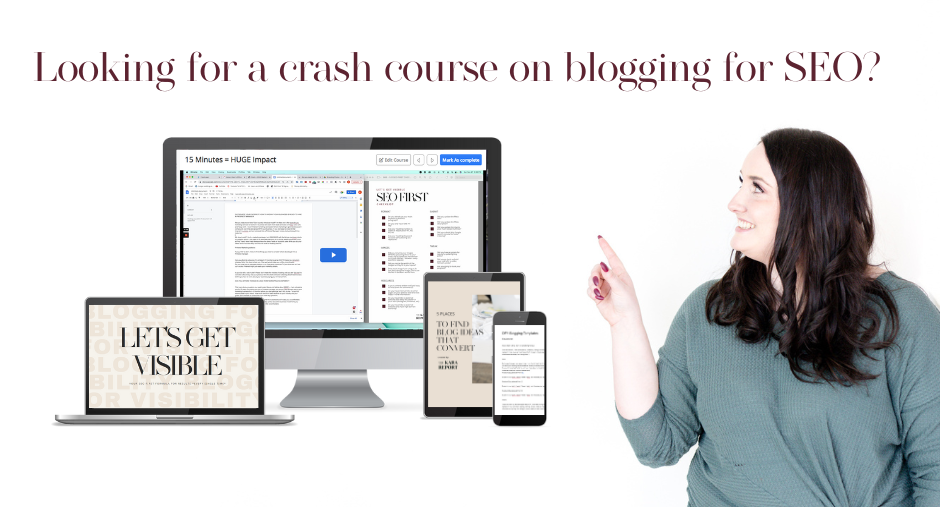
That’s my quick two cents on blogging for conversion, and if you want a deeper dive into this, I go into it in more detail in my mini course, Blogging for Bingeable Brands, which is all about blogging for SEO with strategy behind it.
Bare Minimum Blogging Strategy in 2025
Let’s talk about a bare minimum blogging strategy—especially if you’re short on time but still want to see results.
If you want to take blogging for SEO seriously this year, here’s what I recommend as the true minimum:
- Two blog posts per month
- 1,000 to 1,500 words each (that’s the sweet spot I’m seeing right now)
Now, if you’re in a super competitive industry—like digital marketing or something national/international—you may need to write longer posts to really stand out. On the flip side, if you’re in a very niche or local industry (like a city-based acupuncturist), you can probably get away with shorter posts in the 700–900 word range and still rank well.
A few other essentials:
- Make sure your posts are keyword-optimized
- Keep your writing conversational and easy to read
- Always include a strong call to action at the end
- And include a quick intro about who you are and what you do (not necessarily at the very top, but early on)
One of my favorite tips if you’re stuck staring at a blank screen? Talk it out. Seriously—just record yourself talking through the topic, then drop the transcript into ChatGPT and have it help you turn it into a blog post. So much easier than starting from scratch.
Repurposing Blog Posts
Now, if you want to go just one step beyond “bare minimum,” here’s what I recommend for repurposing:
- Turn each blog post into 1–3 social media posts
- Pull content for one email newsletter
- Create 5–10 Pinterest pins
That way, you’re squeezing as much value as possible out of every blog post—even with a minimal schedule.
And listen, I know some people define “bare minimum” as writing one post per year. Sure, you could do that. But if you actually want to see results, this strategy I’m outlining here is the bare minimum that still moves the needle.
What you really want is for people to click through and actually hire you.
Creating Pins from Blog Posts
Before I jump into the FAQs, let’s quickly talk about how to repurpose your blog content—because this part is so underrated and so valuable.
Here are a few of the ways we repurpose content for our clients:
First, I’ll often turn blog headers into Pinterest graphics. So, if the blog title is something like “Five Steps to XYZ”, that can go on a pin. But you don’t have to stop there—you can also turn each individual step or tip into its own graphic. For example:
- Step 1: Do this
- Step 2: Do that
…and so on. Then add a little line like “Plus 4 more tips inside!” to entice clicks. The goal is to catch different people who are interested in different angles of your content.
Another great trick: I’ll throw the blog post into ChatGPT and ask it to give me 20 headline ideas or pin titles for promoting the blog. Out of those 20, maybe 4 are actually usable—but still, that’s 4 new ways to promote the same blog post with different keywords and different angles.
This is part of data collection that no one really talks about—testing which style of messaging performs better. For example, you could promote the same blog post in multiple ways:
- “3 huge mistakes that mean Pinterest is wasting your time”
vs. - “3 simple things to fix before you blow up your Pinterest traffic”
Same content. Totally different vibes. Different people will be drawn to different messaging, and it’s smart to test that.
More ways to repurpose your blog content
I also love turning blog content into carousel posts or Reels. You’ll notice I already do this with podcast episodes, but I could be doing even more—every blog post could become a carousel or a Reel. You can also break a single blog post into smaller standalone posts. I mean, look at this episode—we’ve covered eight different sections. Each one could be its own piece of content.
Another great option? Use blog post summaries in your email newsletter. You can either encourage people to click over and read the full post on your website, or you can just give them the best parts right in the email—it really depends on your brand and audience vibe.
And one more thing I love to do: take the blog post or transcript and put it into ChatGPT again—this time asking it to pull quotes or quick wins for Instagram captions or social graphics. I know everyone’s obsessed with carousels and Reels these days, but honestly, simple quote graphics still work. Don’t overthink it—you don’t need to reinvent the wheel every time.
The bottom line: you don’t have to create new content from scratch for every platform. One blog post can fuel so many different pieces of content—and this is where you really start to see your effort multiply.
FAQs About Blogging For Your Business in 2025
Alright, let’s jump into some FAQs—a few of these came from you directly, and a few are things I know you’re probably wondering.
1. Is blogging still worth it in 2025?
YES. A thousand times yes. I really hope you’ve picked up on that throughout this episode.
If you’re asking, “Is it still worth starting a blog now?”—I bet you’ve been asking yourself that for the past five years. The truth is:
The best time to start was 10 years ago. The second-best time is today.
Blogging is absolutely still worth it, even now. I recently had a client start blogging and using Pinterest with us around November—and in the first three months, they saw over 2,500 clicks. That’s incredible. (Not promising those exact results, of course—every case is different—but it shows what’s possible.) Whether it takes three months or longer, the point is: starting now is still powerful.
2. How long should a blog post be?
A good general rule is 1,000–1,500 words.
- For older blogs with high domain authority or super niche local businesses, 700–900 words might be enough.
- For highly competitive topics or industries, aim for 2,000–2,500 words or more.
That said, when I repurpose podcast content into blog posts, I sometimes hit 5,000–7,000 words. If you’re going long, just make sure it’s super skimmable—use headings, bullet points, and even a table of contents if needed.
Here’s a quick example: One client wrote a 9,000-word blog post (in Google Docs!) and didn’t want it to go to waste. So, we split it into six blog posts—one for each step of her framework—and created one pillar post to introduce all six, linking out to each one individually. That structure boosted her internal linking, made it more digestible for readers, and kept people clicking around longer.
3. What’s the best blog platform?
The honest answer? You can rank on pretty much any platform.
That said, my personal preference is WordPress (or Showit + WordPress) because it offers the most flexibility and functionality for blogging.
But I’ve had clients successfully rank on Squarespace, Wix, and Webflow, too. So don’t overthink it too much. The only platform I don’t love for blogging is Substack, just because I think it’s better to build on your own domain—you’re investing in content, so keep it on your turf.
4. What if I hate writing?
Totally fair. In that case, you’ve got three options:
- Hire someone (hi, I’d love to help!)
- Use AI tools to streamline the process
- Talk it out and reformat—literally record yourself explaining your topic, then have ChatGPT help you turn it into a blog post
It’s kind of like taxes. I hate doing them, but I still do them—because I want the results (a.k.a. not going to jail). Same with blogging: if you want the long-term results, you’ve got to find a way that works for you.
Also, keep in mind—blogging isn’t the only search-driven marketing channel.
If video is more your thing, try YouTube. It’s also a great search platform.
Podcasting can work too, but it’s not as discoverable—unless you pair it with a well-optimized blog post (not just a basic transcript, but the kind of full, skimmable show notes I do for my own episodes).
5. How long does it take to see results from blogging?
Realistically, 6–12 months is when you’ll start to feel momentum build. You might see a slow climb around the 3-month mark, but unless you’re hitting page one on Google, you might not see much conversion just yet.
You’ve got to celebrate the early wins—like moving from page 6 to page 4. Those shifts matter. But remember, most people aren’t clicking past page one, so that’s the goal.
6. How long does it take to write a blog post?
I typically spend about 2–3 hours per post. And before you tell me you don’t have time—go check your Instagram screen time 😉.
Of those 2–3 hours, probably only 1 to 1.5 hours is spent writing. The rest is formatting, selecting images, tweaking SEO, and polishing things up. Writing is important, but it’s not the only piece.
Blogging For Your Business in 2025
Blogging is a long-term SEO and trust-building tool. It doesn’t need to be perfect, but if you’re consistent and genuinely helpful, you will see results—in your traffic and in your bank account.
Be realistic with your capacity, but also give yourself a little tough love: Most of us do have time to write a blog post every two weeks. That’s all it takes to make this work.
And if you’re not sure where to start, or you’re on a tight budget, go look at what’s already ranking—then create something better. That’s truly one of the best strategies out there.
If you want help planning your blog content or want to outsource the whole thing, I’ve got two options for you:
- Check out my Blogging for Bingeable Brands mini course (it’s only $97, use code PODCAST20 for 20% off).
- Or just hire me to do it for you—which, let’s be honest, is my favorite option.
Thanks so much for hanging out with me. I can’t believe I kept this under 40 minutes—so if you made it all the way to the end, I appreciate you so much.
Talk to you next week!
LINKS MENTIONED
- Hire us to write SEO-driven blog posts for you
- Join Blogging for Bingeable Brands (Use Code PODCAST20 for 20% Off!)
- Learn more about our Pinterest management services
- Learn more about working with our marketing agency here
- Follow me on Instagram