Updating blog posts for SEO is where most of the actual ROI lives.
Not writing new posts. Not chasing trending topics. Not pumping out content because someone told you consistency means publishing every week forever.
The people getting results right now, myself included, are spending a huge chunk of their content time on posts that already exist. Posts that ranked once and stopped converting. Posts that almost ranked and just need a push. Posts that are doing fine but could be doing so much better if anyone bothered to look at them.
I update blogs for myself and for clients constantly.
And yet most small business owners treat their blog like a one-and-done situation. You publish, you maybe share it once, and then you move on to the next thing. Meanwhile that post is sitting there — maybe even getting traffic — doing absolutely nothing for your business because the CTA is outdated or the content drifted off from what people are actually searching for now.
The truth is that your best-performing posts are probably your biggest missed opportunities.
I am not saying stop writing new content. But if you are spending all your energy on new posts while ignoring the ones that are already working, or almost working, you are making this harder than it needs to be.
This post is going to break down what actually matters when you go back to update old content (not the generic advice about adding a new paragraph and calling it a day).
And if you are reading this thinking you do not even have posts that rank, that nothing you have published has gone anywhere, stay with me. There is a whole section for you. It is usually more fixable than you think.
I am Kara, and I run The Kara Report — a content marketing agency where we write SEO blog posts for small business owners who want to get found on Google without becoming full-time content creators. I also update existing posts for clients because (as you are about to see) not everything needs to be new to work. If you are curious about how search-driven marketing fits into your business, my free private podcast Build It Once, Get Found For Months walks through the whole philosophy.
Table of Contents
Why Your Best-Ranking Posts Are Leaving Money on the Table
Here is what I mean when I say your best posts are your biggest missed opportunities.
Picture your top-ranking blog post. Say it brings in a couple thousand visitors a month and has been parked on page one for a year or two. Sounds great, right?
Now go look at what that post is actually doing for your business. For a lot of people, the honest answer is basically nothing. The CTA at the bottom links to a service you stopped offering months ago. The freebie you mentioned halfway down does not exist anymore. And the intro, the part that is supposed to hook a cold reader and convince them to keep scrolling, was written for a completely different version of your offer.
Thousands of people a month landing on a page that is quietly working against you.
This is incredibly common. And I am not just talking about broken links or outdated offers (though those are bad enough). I am talking about posts that are ranking, getting traffic, doing the thing they are supposed to do from a search perspective — and then completely fumbling the conversion.
As a business owner, you know that getting traffic is not the same as getting clients. And a post that ranks but does not convert is not a success story. It is a leak in your funnel that you have been ignoring because the vanity metrics look fine.
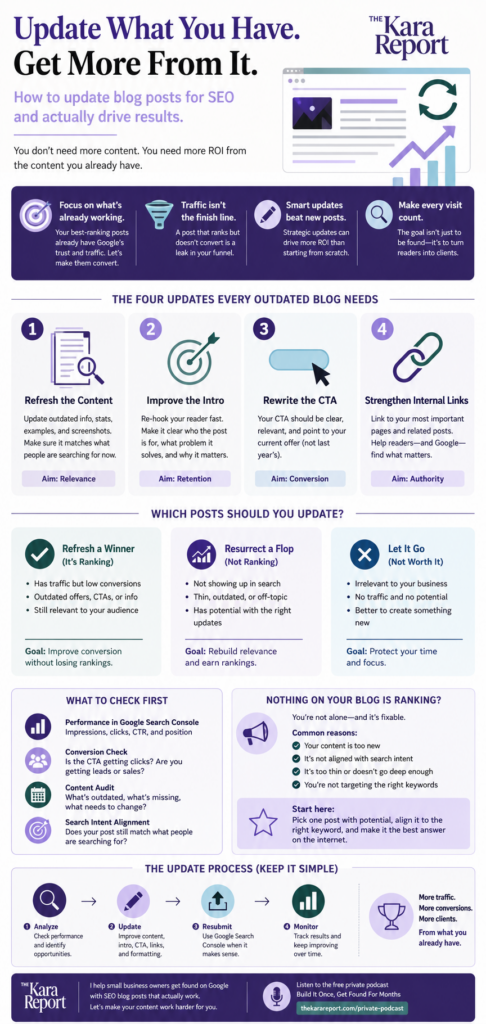
The Four Updates Every Outdated Blog Needs Before It Deserves More Traffic
So if you have a post that is ranking but underperforming, what should you do?
- CTAs that point to something current and relevant (not a dead link, not an old offer, not a generic contact page when you have something better)
- An intro that earns the next scroll from a cold reader (not a warm fuzzy opener written for people who already know you)
- Internal links to your actual money pages (services, sales pages, lead magnets — the stuff that moves people deeper)
- Updated stats, screenshots, or examples if anything looks stale or dated
Most business owners skip straight to wondering whether they need to add 500 more words or reoptimize for a different keyword. Meanwhile the post is linking to a freebie that got retired two years ago. Or the intro spends three paragraphs on backstory before the reader even knows what the post is about. You learn more about the best way to format a blog post here.
You do not need to rewrite the whole post to make it convert better either. Sometimes all it takes is swapping out one CTA and tightening the first two paragraphs.
How to Rewrite CTAs That Actually Convert Instead of Just Sitting There
While you’re updating blog posts for SEO, it’s worth mentioning that your CTAs are probably too vague.
I see this constantly. The reader gets to the end and there is a little line that says something like get in touch or learn more or check out my services. And that is it (if there’s anything at all). That is the entire ask after someone just spent five minutes reading your expertise.
A CTA that converts does three things:
- It tells the reader exactly what they are getting
- It makes the next step feel low-friction
- It connects directly to the problem the post just solved
And here is the part nobody talks about: you probably need more than one CTA per post.
Not in a spammy way. But a cold reader landing from Google is not always ready to hire you on the spot (wouldn’t that be nice though?). Some of them just realized they have a problem. Some of them have been thinking about this for months. Some of them want to keep learning before they commit to anything.
So give them options. A mid-post mention of your freebie for the people who are still warming up. A services link at the end for the ones who are ready. Maybe even a soft mention of your podcast or email list for the folks who want to stick around but are not taking action today.
I do this in every blog I write for clients. And when I go back and start updating blog posts for SEO, the CTA structure is one of the first things I look at.
Submitting Your Updated Post To Google Search Console
Here is a small step most people skip when updating blog posts for SEO, and I want you to stop skipping it: when you update a blog post, go into Google Search Console and request indexing on that URL.
It takes about ten seconds. And it matters more than people give it credit for.
When you request indexing, you are raising your hand and telling Google, hey, I changed something here, come take another look. Without that nudge, Google will usually recrawl the page eventually on its own. But eventually can mean days or weeks, and there is no reason to sit around waiting when you just did the work. Requesting indexing moves you up the line and gets your updated page looked at faster.
And that is the entire point of updating a post. You changed it because you want Google to see it differently now. Resubmitting is how you do that.
So my rule is simple: every time you make a meaningful update, resubmit. New sections, rewritten intro, updated title tag, a shift in structure or angle. Push the button. There is no downside, and the upside is your work gets picked up sooner.
One more thing worth knowing: you can check whether a post is even indexed in the first place by searching site:yoururl.com/post-slug in Google. If it does not show up, that is a more basic problem than ranking, and you definitely want to request indexing to get it into the system. But you should be resubmitting your updates either way. It is one of the easiest wins in this whole process, and it is easy to forget precisely because it is so quick.
What If Nothing on Your Blog Is Ranking?
Okay, but what if you are reading all of this thinking, “Kara, I do not have a best-ranking post”
I hear this constantly when I tell people they need to be updating blog posts for SEO. And I want to say something that is going to land as either really reassuring or really annoying depending on where your head is at right now.
“My blog is not ranking” is almost never the actual problem. It is a symptom. And underneath it is usually one of three things, all of which are fixable.
Let me walk through them.
1. There is not enough of it yet, and it has not been live long enough.
This is the big one. This is most of you.
Here is what I see all the time. Someone publishes eight posts over a few months, checks their traffic, sees almost nothing, and decides blogging does not work. But a blog with eight posts that has been live for four months has not failed. It has barely started.
Google does not rank a brand-new blog with a handful of posts the way it ranks an established one with real depth on a topic. It needs time, and it needs signals, and those signals come from volume and consistency. This is the long game. It compounds. The posts you publish now do quiet work for months before you see the payoff, and then it builds on itself.
I am not telling you to publish five posts and call it a capsule blog. You already know how I feel about that (I talk about the capsule blog trend and other unpopular blogging opinions I have here). More is more. A blog that is not ranking is very often just a blog that does not have enough on it yet to compete.
2. You are writing about things nobody is actually searching for.
You can write the best post in the world on a topic, and if no one is typing that topic into Google, it will never bring you traffic. There is nothing to rank for.
This is the difference between something being interesting and something being searched. Those are not the same thing. Before you write anything, there should be evidence that real people are looking for it. Actual search demand, not just a topic you assume people care about.
Please don’t trust AI tools to come up with the keywords. My favorite affordable SEO keyword tool is Keysearch (*affiliate link) and I recommend it to everyone!
3. You are swinging way above your weight class.
If you are a newer site trying to rank for big, broad, competitive keywords, you are going up against websites with years of authority behind them. You will lose that fight.
The fix is not to write harder. It is to get more specific. Longer, more specific phrases have less competition and a clearer intent, which means a newer site actually has a shot. You earn authority on the small, specific stuff first, and that is what eventually lets you compete for the bigger terms.
So before you decide blogging does not work for you, figure out which of these you are actually dealing with. Nine times out of ten it is the first one. You did not fail at blogging. You stopped right before it was about to start working.
And if the real issue is that you know you need more content but you genuinely do not have the time to sit down and write a dozen posts, that is exactly what I built The AI Blog Sprint for. If you’re interested in hopping on the waitlist to learn more, click here.

Frequently Asked Questions
Before you start updating blog posts for SEO in 2026, read this.
Do I need to update every old blog post on my site or just some of them?
Not every post deserves your time. Focus on the ones that are already getting traffic but not converting, or the ones that almost ranked and just need a push. Posts with no search demand or posts competing against sites way out of your league are usually better left alone — or scrapped entirely so you can redirect that energy somewhere it will actually pay off.
How do I know if an update actually worked or if I just wasted my time?
Give it at least two to four weeks before you start judging. Check whether impressions and clicks are shifting in Google Search Console, and look at what people are actually doing on the page — are they clicking your new CTA, are they staying longer, are they bouncing less. If nothing moves after a month, the update either was not substantial enough to matter or the post has a deeper structural problem that a surface refresh cannot fix.
What if I only have time to update one or two posts right now — is that even worth doing?
Yes. One well-chosen update on a post that is already getting traffic can do more for your business than three new posts that start from zero. You do not need to overhaul your entire archive to see results — start with the post that is ranking but not converting, fix the CTA and tighten the intro, and see what happens. Progress beats perfection here.
I have been blogging for months and nothing is ranking. Should I just give up?
Probably not, and these updating blog posts for SEO tips should help. Ask yourself: How many posts do you actually have, and how long have they been live? If the answer is something like eight posts over four months, you have not given it enough to work with yet. If you have real volume and real time behind it and still nothing, look at whether you are targeting things people actually search for and whether you are competing above your site’s authority. Give up only after you have ruled those out, which most people never actually do.
Now You Know How To Start Updating Blog Posts for SEO
Most people treat their blog like a publish-and-forget situation. You now know why that is costing you when you blog for years and never go back to start updating blog posts for SEO.
And if you are at the earlier stage, the one where nothing is ranking yet, the answer is almost never that blogging does not work. It is that you have not given it enough to work with. t.
This is the work I do constantly for myself and for clients. Not because updating old content is glamorous, but because it is where the ROI actually lives. If you are starting to look at your own archive differently now, good. That is the point. You do not need to overhaul everything tomorrow. Pick the post that is already getting traffic and ask yourself what it is actually doing for your business. Start there.
And if you want to go deeper on how search-driven marketing fits together — the philosophy behind why this works and what it looks like to build content that keeps working for you — my free private podcast Build It Once Get Found For Months walks through all of it here.
If you are at the point where you would rather hand the updating off entirely, that is what I do. I write and update SEO blog posts for small business owners who want to get found on Google without becoming full-time content creators. Learn more about hiring a blog writer for your business here.
Either way, you have what you need to stop ignoring the posts that are already doing half the work for you. For more info, head to my Youtube channel where I talk all about business and entrepreneurship.