Most blog formatting advice assumes your reader already trusts you. They came from your Instagram. They binged your podcast. They know your vibe and they are ready to read whatever you put in front of them.
That is not how most blog traffic actually works.
If your post ranks on Google — which is the whole point of writing it — the person landing on it has never heard of you. They typed a question into a search bar. They clicked a link. And now they are deciding in about five seconds whether you are worth their time or whether they are going to hit the back button and try the next result.
This is where most small business owners lose people. Not because their content is bad, but because the format for writing a blog was never built for cold readers in the first place.
The structure that works for your existing audience — the slow build, the personal story at the top, the big reveal at the end — does not work for someone who just met you. They do not have context. They do not have patience. They need to know immediately that you can help them.
So if your blog is supposed to be a lead generation tool and not just a place for your current followers to hang out, the format for writing a blog has to change.
This post breaks down what that actually looks like.
- How to structure a blog so the first five seconds earn the next five minutes
- Where to introduce yourself when the reader did not come from your homepage
- How to deliver real value without burying the thing they came for under six paragraphs of backstory.
I am Kara, and I write SEO blog posts for small business owners who want to get found on Google without having to become full-time content creators. If you are still figuring out how search-driven marketing fits into your business, my free private podcast Build It Once, Get Found For Months is a good place to start.
Table of Contents
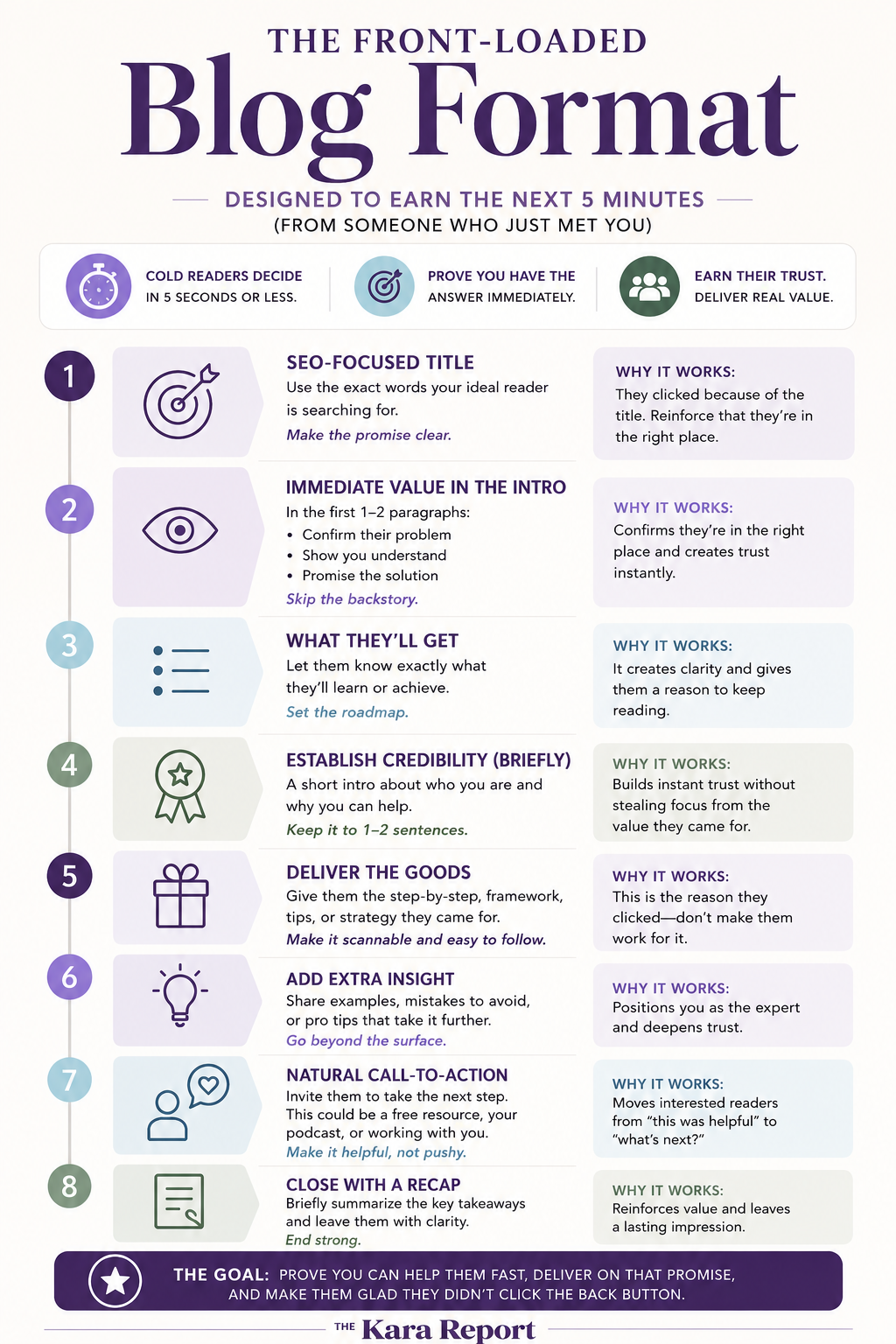
What Cold Readers Need in the First Five Seconds of Your Blog
Here is the thing about cold traffic: they owe you nothing.
When someone lands on your blog from Google, they are not there because they like you. They are not there because they saw your Reel and thought you seemed cool. They are there because they have a problem and your post showed up in the search results.
That is it.
And in those first five seconds, they are asking one question: does this person actually have the answer I am looking for?
I see this constantly with the blogs I write for clients. The original draft will have a beautiful opening paragraph about their journey into the industry or a thoughtful reflection on why this topic matters to them personally. And I get it — that stuff feels important. It feels like connection.
But to a cold reader? It feels like filler.
They do not know you yet. They have not earned that context. What they need is proof that you understand their problem and that the answer is coming.
That means the first five seconds of your blog have to do three things:
- Confirm they are in the right place
- Signal that you know what you are talking about
- Make it obvious the answer is below
You prove it immediately or you lose them to the next search result.
The Front-Loaded Format For Writing a Blog That Keeps Strangers on the Page
Most blog posts are structured like a conversation with someone who already cares. You build up to the good stuff. You earn the reveal.
That structure fails cold readers immediately.
The format that actually works for search traffic is the opposite. You lead with the answer. Then you explain why. Then you go deeper.
This is called front-loading, and it is the single biggest shift most small business owners need to make in how they write blog content.
Here is what front-loading looks like in practice:
- The main answer or takeaway appears in the first few sentences
- The body of the post expands on that answer with context, examples, and nuance
- The structure rewards skimmers and deep readers equally
I know what you are thinking. If I give away the answer at the top, why would anyone keep reading?
Because the answer is not the value. The understanding is.
When someone lands on your blog from Google, they want to know immediately that you have what they came for. If you make them scroll through four paragraphs of setup before you actually say the thing, they assume you do not have it.
But if you answer their question right away? Now they trust you a little. Now they want to know why that answer works. Now they are curious how to actually implement it.
The answer earns their attention. The explanation keeps it.
This is exactly how I write blogs for clients. We do not bury the lead. We do not make people hunt for the point. The format assumes the reader is one scroll away from leaving and builds trust by being immediately useful.
Where to Introduce Yourself When the Blog Is the First Touch
Once you have hooked them, introduce yourself. Quickly.
This is the order I always teach: intro, then introduce yourself, then get into the topic. Your opening confirms they are in the right place. Your introduction tells them who is doing the talking. Then you get into the good stuff.
And yes, the introduction goes near the top. Not buried six paragraphs down where only the deep readers will ever find it.
Here is why. Your reader is skimming. If they cannot tell who you are without scrolling halfway down the page, most of them never will. A quick line about who you are, placed early, does that work while they are still deciding whether to stay.
But keep it short.
This is not your bio. It is not your origin story. It is not the place to list every client you have worked with or every year you have been in business. To a cold reader, none of that means anything yet.
What they need is just enough context to keep reading with a little more trust than they had a second ago.
So keep it to a sentence or two:
- Your name
- What you do
- Maybe one line on why your take on this topic is worth trusting
- A soft CTA to your email list or services page
That is it.
I do this in every blog I write for clients, including this one. The intro is short, it comes early, and then we get straight into the topic. The reader knows who is talking before they have to commit to anything. And because it is quick, it never reads like a sales pitch they have to scroll past.
Structuring the Core Content So It Delivers Without Fluff
Now that you have their attention and they know who you are, the middle of your post has one job: deliver on the promise without wasting their time.
Here is what I mean. A lot of small business owners write blog content the way they would explain something in a discovery call. They give context. They share examples. They go on tangents that feel relevant in the moment. And in a conversation, that works — the other person can nod along or ask clarifying questions.
But a cold reader does not have that patience. They are scanning. They are skimming. They are looking for the part that applies to them and skipping everything else.
So the structure has to do the work for them.
Here is what that looks like:
- Use subheadings that state the point, not tease it
- Keep paragraphs short (three to four sentences max)
- Break up long explanations with single-line statements that anchor the idea
- Use bullet points for steps, options, or anything that benefits from visual separation
The goal is not to strip out depth. It is to make depth accessible.
FAQs That Answer What Your Reader Was Too Impatient to Scroll For
Most people do not read your entire blog post (even though as a blog writer, that breaks my heart a little). An FAQ section at the end of your post catches those people. It gives them one more chance to find exactly what they came for — without making them dig through paragraphs they already skipped.
Your FAQ section should not be a dumping ground for leftover points you could not fit elsewhere. It should anticipate the objections and follow-up questions your reader is already forming.
Think about it this way:
- What would they Google next if this post did not fully answer their question
- What part of your advice might they push back on or misunderstand
- What logistical detail might stop them from actually implementing what you taught
Those are your FAQs.
Keep the answers short. Two to four sentences max. If an answer needs more than that it probably deserves its own section in the post — or its own post entirely.
And format them so they are easy to scan. Bold the question. Keep the answer tight. Do not bury useful information inside a paragraph that looks like everything else on the page.
Frequently Asked Questions
See what I did there…
What if my blog post is short? Do I still need all these formatting tricks?
Even shorter posts benefit from front-loading and clear structure. A 500-word post still needs to answer the question immediately and use subheadings that tell the reader what they are getting. The length does not change the fact that a cold reader is deciding in five seconds whether to stay or leave — so make those five seconds count regardless of word count.
What if my niche feels too personal or relationship-based to lead with the answer right away?
Even in niches where connection matters, cold readers still need proof you understand their problem before they care about your story. You can absolutely weave in warmth and personality… just do it after you have confirmed they are in the right place. Lead with relevance first, then let your voice and values come through as they keep reading.
Give Them More Than One Way to Take the Next Step
Most advice tells you to pick one call to action and stick to it. I do not write them that way.
When someone finds you through Google, you have no idea where they are in their journey. One reader just realized they have a problem and wants to learn more. Another has been quietly reading your stuff for months and is finally ready to hire someone. A third is somewhere in the messy middle, not ready to buy but not ready to leave either.
If you give them only one way forward, you are betting they are all standing in the same spot. They are not.
So give them options:
- A freebie for the reader who wants more but is not ready to commit (my free private podcast does exactly this)
- A way to follow your work for the reader who likes you but needs more time, like YouTube, a podcast, or your email list
- A contact or services link for the reader who is ready right now
Your job is to make sure that whoever lands on the post, there is a next step that fits where they actually are.

Now You Know How to Format a Blog for People Who Just Met You
Most blog posts are written for people who already trust the writer. Now you know why that costs you readers — and what to do instead.
Front-load the answer. Introduce yourself after you have proven you are worth listening to. Structure the middle so skimmers and deep readers both get what they need. And use your FAQ section to catch the people who scrolled past everything else.
This is the format I use for every blog I write for clients. Not because it is trendy or clever, but because it works for the reader who matters most — the one who just found you and has no reason to stay.
If you want to see how this fits into a bigger search-driven marketing strategy, my free private podcast Build It Once Get Found For Months breaks down the whole approach.
And if you are at the point where you would rather hand the writing off entirely, that is what I do. I write SEO blog posts for small business owners who want to get found on Google without becoming full-time content creators.
Either way, you have what you need to start formatting your posts for the cold readers who are already searching for what you offer.
Now go make those first five seconds count.