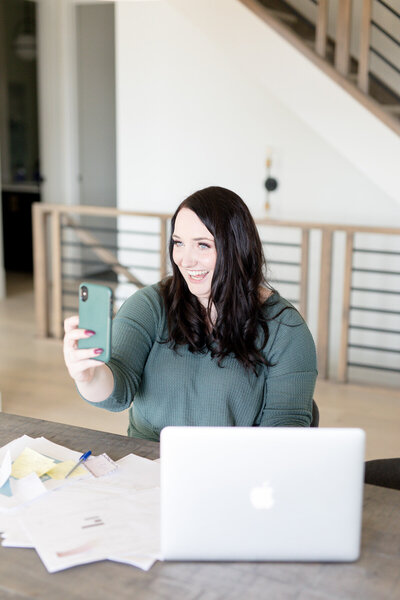
I quit Instagram almost two months ago, and the best way I can describe it is this: it felt like taking the deepest breath of fresh air.
I know that sounds dramatic—especially coming from someone recording a podcast alone in their office, not exactly basking in some serene, phone-free utopia. But genuinely, I didn’t realize how heavy Instagram felt until I put it down. The relief was immediate, and two months later, it hasn’t faded. If anything, I’m more certain now than I was at the beginning that this was the right decision for me.
I want to be clear about something upfront, though. This is not an anti-Instagram manifesto. I’m not turning this podcast, or my work, into a crusade against social media. What I am sharing is a business decision I made after sitting with the data, the experience, and my own energy for a long time… and also, strangely, a very short time.
In this post, I want to take you behind the scenes: why I made the decision, what the data actually showed, what, if anything, I’m still doing on Instagram, and what I think you should consider if you’ve ever quietly wondered, Do I actually need this platform?
Since I shared my nine-grid post, I’ve been tagged in threads and conversations where people say things like, “That’s it, I’m quitting too.” And while part of me wants to shout, Yes! Do it!, I also know it’s not that simple. My decision isn’t automatically the right decision for everyone.
I was originally going to record this episode right after I posted that nine-grid. I’m glad I didn’t. Two months ago, I felt good—but I wasn’t sure if that feeling would last. Now, with a little distance, I can say confidently: I love that I made this decision.
So let’s get cozy and talk about it.
Table of Contents
A History Lesson For The Kara Report Instagram
I want to rewind for a second, because quitting Instagram wasn’t a sudden, impulsive decision.
If you’ve been in my world for a while, you already know this, but for anyone newer here, I started my Instagram account almost six years ago. I’ve never been a perfectly consistent poster. In the early years, I’d call it semi-consistent. There were stretches of regular posting, followed by periods where I completely disappeared.
That changed over the last two years. Once I launched this podcast, I showed up on Instagram at least once a week to promote each episode—minimum. From March through October 2025, I went all in. For seven or eight months, I was posting four to five times a week: reels, carousels, static posts, brand photos, talking-head videos—everything.
Hiring a Social Media Manager
And when I say we, I mean I hired a social media manager for six months. This wasn’t casual. It was a significant investment in my business, and not a “throw up a few posts when you have time” situation. I was very intentionally saying: I am committing to Instagram, and I am going to make this work.
This is not a story about a bad hire. She was great. I genuinely loved the content we created together. We tested formats, hooks, angles, B-roll—everything you’re “supposed” to do. This wasn’t dabbling and then quitting. I can say confidently that I gave Instagram a real, sustained effort.
We worked in two three-month contracts. After the first three months, nothing had really moved—but I’m a realistic business owner. Growth takes time, even on a platform I usually think of as relatively fast-moving. So we did another three months.
At the end of that second contract, I had to face the numbers. I couldn’t justify continuing to pay for social media when there was no return on investment.
Feeling The Pull To 9-Grid My Instagram
That’s when I started feeling pulled toward doing a nine-grid and stepping back. I’m very all-or-nothing by nature, and it honestly felt like my two options were: commit fully again, or stop entirely. In true irony, during that same period I signed up for two Instagram memberships, which now makes me laugh.
My best friend Laura—who you’ve heard me mention on the podcast and who is literally a social media manager—listened to me complain endlessly. I was exhausted. I was doing “all the things.” I wasn’t going viral. And this was happening at the beginning of Q4.
Q4 is typically the biggest quarter of the year. Black Friday. Christmas. End-of-year spending. Even though Instagram wasn’t bringing me leads, it felt almost irresponsible to slow down then. Once a year, I sell batch blog packages at the end of the year, and I kept thinking, How am I supposed to market this without Instagram?
I knew I had the podcast. I knew I had my email list. But my list is small—about 265 people. Tiny, but mighty. Still, Q4 didn’t feel like the time to rest. It felt like the time to push.
PS: If you aren’t on my email list, you can sign up here.
So I kept whining—but I was also researching.
What Finalized My Decision to Quit Instagram
Then, in mid-November, something small pushed me over the edge: trial reels.
One of the Instagram memberships I was in hosted a webinar all about trial reels and how to use them strategically. I was actually excited. I had a plan. I was ready to try something new.
And then I realized… I didn’t have access to trial reels.
That was it.
What sent me over the edge wasn’t just the feature—it was the realization that I’d built momentum, learned the rules, created a strategy, and still didn’t even qualify for the tools I was being told would make it work. On paper, I should have qualified. It genuinely never occurred to me to check beforehand.
That moment crystallized everything I’d already been feeling.
At that point, I had over a thousand followers and a public account. On paper, I should have had access to trial reels. I didn’t.
That was the moment I thought, I am done.
What’s important to say here is that this wasn’t about hating content creation. I don’t hate it. Most of the time, I actually enjoy it. I would finish a piece of content and think, This is good. I’m proud of this. People are going to love it. Then I’d post it… and nothing would happen. A few supportive comments from existing clients—who are incredible, by the way—but no momentum, no discovery.
This also isn’t me blaming the algorithm. I don’t think Instagram owes me anything. What did start to happen, though, was that my time on the platform spiraled.
Starting To Do The Math And Looking At The ROI Of Instagram
That shift really began when I hired a social media manager. Not because she did anything wrong—she didn’t—but because once you’re spending real money on something, you start watching it like an investment. It’s similar to running ads. You pay attention to performance. You refresh. You analyze.
When I took Instagram back over myself, I felt like I had to match—or exceed—the effort if I wanted better results. And suddenly, the time commitment wasn’t just about creating content. It was everything that came after: checking performance, refreshing insights, watching my own stories, second-guessing captions, following people who post Instagram “hacks” even though I know better.
It was taking hours. And it didn’t feel good.
Not in the “business is hard sometimes” way—but in a very specific, draining, discouraging way. I was pouring time into something that wasn’t moving, and that kind of stagnation messes with your head. Quietly, all of this was piling up in the background.
Eventually, I realized I needed to take the emotion out of it and look at the numbers.
So I pulled my data. This was easy because I track everything. In the most recent month where I was posting five times a week, I got nine link clicks total from Instagram.
Nine.
For context, the following month—December—when I posted nothing on Instagram, I still got eleven link clicks. A few stories, maybe a thread or two, but no feed posts. Posting consistently made no measurable difference.
Comparing Instagram’s ROI To Other Platforms
I also looked at follower growth. Over the past year, my average month-over-month growth was about 1.5%. And that might sound fine until you remember I don’t have a massive following. This wasn’t meaningful scale. It was slow, incremental crawling.
Then I compared that to my other channels. I’d only been sending weekly emails consistently for a few months at that point, and I wasn’t even actively promoting a freebie. Still, my email list was growing at closer to 2.4% per month—with almost no time investment.
The growth difference itself wasn’t the point. The time difference was.
Instagram was taking hours every week. Email took less than an hour.
That’s when it clicked.
This wasn’t a mindset issue. It wasn’t burnout. It wasn’t impatience. The data was telling me very clearly that Instagram did not deserve the level of energy I was giving it.
That weekend, I designed my nine-grid. I sent it to a friend. Two days later, I posted it.
And that was it.
The numbers didn’t support continuing—and I didn’t want to do it anymore.
What’s Specific To My Business That Led Me To Quit Instagram
Before I get into what I’m still doing on Instagram, how I’m marketing my business without it, and what you should consider if you’re thinking about going nine-grid or stepping away, there’s one more thing I need to name.
One of the core messages people associate with my work is that you don’t need Instagram. That message either deeply resonates—or doesn’t—but it’s been part of my positioning for a long time. And while my business is absolutely not anti-Instagram, there was a growing internal tension I couldn’t ignore.
Many of my clients use Instagram very effectively alongside blogging, Pinterest, podcasting, and other platforms. Instagram can be a great supporting channel. But the irony was this: people mostly see me on Instagram.
So I was out here saying, “You don’t need Instagram,” while actively marketing myself on the very platform I was telling people they could opt out of. That disconnect started to feel increasingly uncomfortable.
And here’s the thing—I know, with certainty, that you can market a business without Instagram because I already do.
When I pulled my lead data, I realized I’d gotten maybe two leads from Instagram in the last year—possibly even two years. I’m grateful for them, of course. But my business would have survived just fine without those leads. Instagram was not a critical driver of revenue or growth.
At the same time, I could clearly see that I didn’t have a particularly engaged audience on Instagram and I wasn’t getting clients from it. And I had proof from elsewhere in my life that this wasn’t some catastrophic omission.
My wedding business, Love It First Travel, barely uses Instagram at all. We post when couples get married and share their photos—mostly to celebrate them. Sometimes we post save-the-date photos, often pulled from resorts or stock imagery. Occasionally, we’ll share a story when couples are headed off on their trip.
That’s not a growth strategy.
It’s not optimized. It’s not algorithm-friendly. It’s simply a way to nurture existing clients—and in the wedding industry, that actually makes sense. Couples who hire you tend to follow you more closely after booking, not before.
We have a presence, but it’s minimal and intentional. And the business thrives anyway.
That contrast made things very hard to ignore.
At its core, Instagram marketing—at least for me—had become more of a nurture channel than a growth engine. So when I say, you don’t need Instagram to grow your business, that statement is still 100% true. But I also started asking myself an uncomfortable question:
Can someone really believe that message if they’re watching me actively market my business on Instagram?
What I Kept After I Quit Instagram, What I Dropped, and What Filled the Space
Around the same time, the State of Small Business report from Enji came out. I’ll link it if you want to read the full thing, it’s genuinely interesting, but one stat stopped me in my tracks: over half of small business owners said they would quit at least one social media platform if they felt like they could.
My immediate reaction was, Of course. But no one wants to be the first one to leave. People feel trapped because there aren’t enough visible examples of businesses that don’t rely on Instagram, and that felt like something I could change.
If you want to go deeper into that idea, episode 100 of the podcast breaks down three different clients of mine who run completely Instagram-free businesses, all with very different models and marketing strategies.
Now, despite loving a dramatic moment, I didn’t delete the app and disappear forever.
What I’m Still Doing on Instagram
I still have Instagram on my phone. I use stories occasionally. I posted one of those end-of-year recap stories in December. I like having the option to post a reel if I’m a guest on a podcast, collaborate with someone, or potentially run ads in the future.
I also genuinely like Instagram as a consumer. I follow my clients there, and it’s one of the best ways for me to hear how they actually talk “in the wild.” That matters for my work—especially when I’m helping them with blogging and messaging. On top of that, I manage Instagram content for a few clients, so practically speaking, I need access.
What I don’t do anymore is maintain a feed for the sake of maintaining a feed.
When I first posted the nine-grid, I remember wondering what I’d do with all my extra time. I had ideas: maybe I’d experiment more with stories, maybe I’d repurpose carousel-style content there instead. In reality? I haven’t wanted to.
I don’t miss it. At all.
I like that I can post stories when I want. I like that I can publish a reel if it serves a specific purpose without pinning it to a main grid. Beyond that, I feel no pull to be on Instagram—and that surprised me.
Where That Time Went Instead
Almost immediately, Parkinson’s Law kicked in: the time I used to spend on Instagram went somewhere else.
The first week after posting the nine-grid, I recorded three YouTube videos. YouTube is something I struggled to stay consistent with throughout 2025, and being consistent there is one of my biggest goals for 2026. Cutting Instagram out of the equation made that possible.
I posted more on Threads when I felt like it. I had more time—and more mental space—for my weekly emails. I realized I’d been spreading myself too thin and quietly comparing myself to other businesses, which is one of the fastest ways to burn out.
Overall, I just felt lighter.
I knew right away that this was the right decision. Two months later, that feeling hasn’t faded. The relief didn’t wear off. If anything, it confirmed what I already suspected.
Should You Quit Instagram?
Now, here’s the important part: I don’t think everyone should go post a nine-grid tomorrow.
If we were sitting down for coffee, the first question I’d ask you is simple:
Where are your current leads actually coming from?
That’s where this conversation really needs to start.
If You’re Thinking About Quitting Instagram, Read This First
Ask yourself these four questions first:
1. If you quit Instagram tomorrow, how would people find you?
This is the most important question to answer.
2. How are you currently nurturing existing clients?
Instagram isn’t always a growth channel—but it is often a nurture channel. And that role matters.
3. Do you already have another platform that is:
- Built
- Consistent
- Visible
4. What’s driving this decision—excitement, frustration, or both?
Emotion-driven decisions aren’t bad, but awareness matters. Be honest about what’s motivating the change.
I Know It’s Tempting To Quit Instagram
Especially on Threads, I see people wanting to quit Instagram without another marketing channel in place.
Sometimes that looks like:
- “I’ll just start a Substack”
- “I’ll figure it out as I go”
I’ll be blunt: unless you already have a blog and an SEO strategy, Substack is unlikely to serve your business. It’s far more likely to become another hobby.
Where are your leads coming from right now?
If Instagram is your primary—or only—source of leads, wanting to quit Instagram doesn’t automatically mean you can quit.
Every platform takes time to build.
If Instagram is currently keeping your business afloat, you may need to stay on it while you build something else in parallel.
I’ve been in business for five years. I’ve spent years building my SEO and referral network—that’s where most of my clients come from.
If that weren’t true, I’d still be experimenting. And yes, that might include Instagram.
Don’t Overlook the Nurture Piece
I’ve learned this the hard way.
In 2021, I went through a period of burnout and essentially ghosted my audience. One thing became very clear: People feel more connected when they see you, hear from you, and interact with you regularly.
For wedding vendors, this often matters less after booking—clients have already signed a contract.
For service providers who rely on ongoing, month-over-month relationships, that connection matters more.
That’s something I’m actively watching.
If I’m not nurturing clients on Instagram, that role has to be filled elsewhere—which is why I’m intentionally leaning into:
- My podcast
- YouTube
Those channels now need to do the work Instagram used to do.
One Final Reality Check If You Want To Quit Instagram
Most of us have had Instagram accounts for years.
It’s unrealistic to expect a brand-new platform to replace that overnight.
If you’ve spent three, four, or five years building Instagram and then give yourself six months to “make YouTube work,” that’s not a fair comparison—and it’s a fast path to discouragement.
If You Decide To Quit Instagram, Don’t Just Disappear
Make it intentional.
Most people find me through Google. But I know they still vet me on Instagram. I can see people follow me right before, or right after, they inquire. Even if you’re not posting regularly, your presence still matters. A dead account can look like a closed business.
That’s why I don’t think you need to decide whether you’ll never post again. You don’t need a perfect, all-or-nothing plan. What matters is clarity and intention.
What I know right now is this: my business doesn’t need Instagram. My nervous system doesn’t need Instagram. And I’m excited to spend that time on other ways of marketing that feel more sustainable.
Unless I’m running ads—where I’d post very specific, intentional content—you probably won’t find me actively posting on Instagram.
So if you want to stay connected, make sure you’re subscribed to the podcast and on my email list.
And with that… yeah. I quit Instagram. I’m excited to see how 2026 goes!
Thank you for being here!