I used ChatGPT to help me plan my year, and I want to talk about that experience—how I used it for goal setting, what worked, and what didn’t. You might relate to it, or you might listen and think, “You’re missing something.” I’m also going to share my 2026 business goals and do a quick reflection on how 2025 went.
Honestly, these are my favorite types of episodes to listen to, but this year, when I listened to a few 2025 recaps, everything felt a little too neatly wrapped up—like the lessons were tied with a perfect bow. This isn’t that.
I had to plan my year in a very realistic way—between nap times… or honestly, not even nap times, because this kid has not napped all Christmas break. So really, it was in the evenings, in those little pockets of time.
I also felt a lot of pressure because I knew this episode was coming out. On top of that, I love doing quarterly Looms with my team to share the plan, and the beginning of the year is always such a big, exciting moment. It felt like there was pressure to wrap everything up perfectly and it’s just not quite there yet.
I don’t have 13 polished lessons from 2025. It’s more like, “If you listened to episode 55 where I shared my business goals from last year, you heard me talk about my words of the year and my focuses—and here’s how that actually went.”
So, without further ado, let’s get into it.
Table of Contents
When I Started Planning My 2026 Business Goals
I started goal-setting in the last couple weeks of December (which is late for me).
That’s actually something I literally put into ClickUp: start goal setting earlier. Because by mid-December I was like, “Wait… I still don’t know what I’m doing for 2026,” and that felt strange to me.
If that’s where you’re at, by the way, you’re not alone. I did get a huge surge of goal-setting inspiration over Christmas break. I think that’s just what happens—you get swept up in the vision board TikTok algorithm, the aesthetics, all of that. It was interesting to notice. But I really do prefer starting earlier, so I made a note for myself to remember that next year.
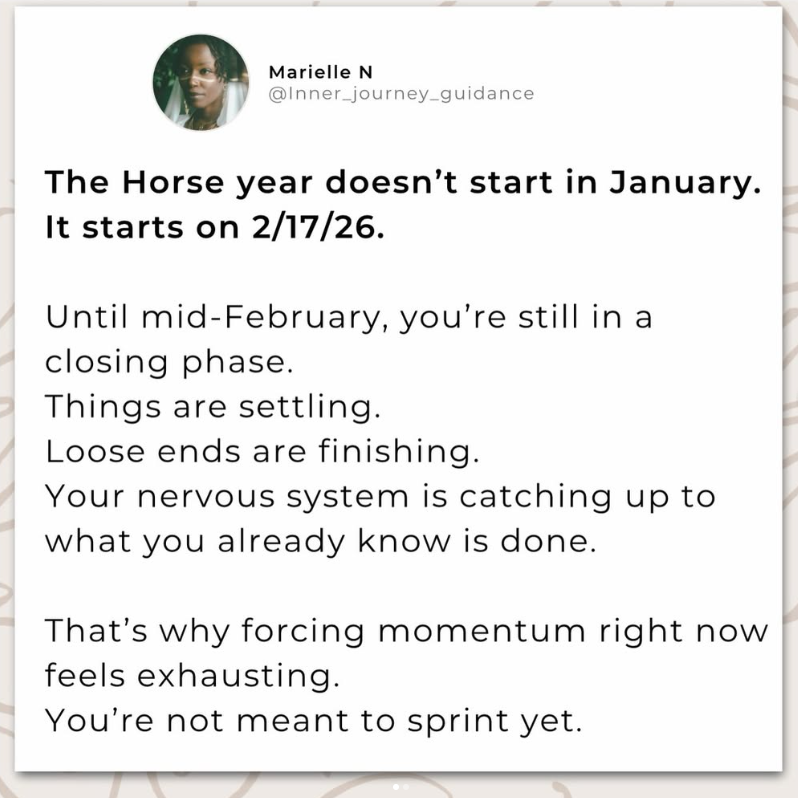
Actually, I want to share something I posted on Instagram Stories. It was from @inner_journey_guidance, and it said:
“The Horse year doesn’t start in January. It starts on February 17th, 2026. Until mid-February, you’re still in a closing phase. Things are settling. Loose ends are finishing. Your nervous system is catching up to what you already know is done. That’s why forcing momentum right now feels exhausting. You’re not meant to sprint yet.”
I’ll be honest—I’m recording this on January 2nd, and I already feel a little behind. This episode is supposed to go live on the 6th. I don’t know if it will. I feel like I’m cutting things way too close with my poor editor, who always tries to accommodate me no matter what kind of hot mess I am. That’s something I definitely want to get back on track with.
But my point is: this just isn’t how I love to start a new year. I’m out of my routine. I’m very ready to get back into full-time childcare next week. I still have some client things pending that I hoped I’d already wrapped up. All of that makes it harder to drop into a big, expansive goal-setting mood.
Using a Coaching ChatGPT Prompt for 2026 Business Goals
That said, I did get into it.
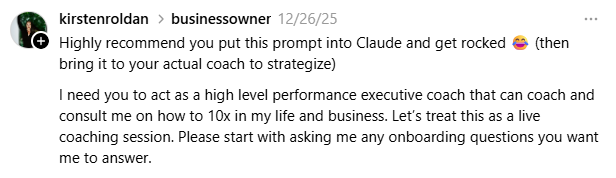
I had maybe an hour to myself one afternoon, and I was scrolling Threads when I saw a post from Kirsten Roldan. I think she’s a business coach, I’m not super familiar with her, but her post said, “Highly recommend you put this prompt into Claude and get rocked, then bring it to your actual coach to strategize.” I’ll share a screenshot of that in the blog as well.
Here was the prompt:
“I need you to act as a high-level performance executive coach that can coach and consult me on how to 10X in my life and business. Let’s treat this as a live coaching session. Please start by asking me any onboarding questions you want me to answer.”
And I was kind of like, “You know what? What the hell. Let’s try it.”
I was curious because I’ve never really used AI for something like this. I’ve also never been great at super high-level planning. I feel confident that I’m good at goal setting—but if things get too big-picture, I struggle. I don’t have a five-year plan. I definitely don’t have a ten-year plan. When the goal feels massive, I get overwhelmed and don’t know how to break it into chunks.
That’s why the whole “I work ten hours a week and make a million dollars a year” thing feels so foreign to me. I wouldn’t even know how to approach that.
So I tried the prompt. And at first, I was like, “Have I been sleeping on this?”
What I Liked About Goal Setting with ChatGPT
I actually really liked some of the questions it asked and some of the mindset reframes it gave me. A couple stood out.
Things like:
- “If your business had to become boring but extremely profitable, what would you miss emotionally?”
- “If you keep doing this weekly for the next year, will your life get better or worse?”
So I basically just word-vomited. I highly recommend starting a prompt like this, taking a bath, and then voice-noting ChatGPT—that’s what I did, and it honestly felt like a vibe. It felt like the start of a coaching session. I wasn’t overthinking; I was just saying whatever came to mind.
And like ChatGPT tends to do, it took my very incoherent thoughts and summarized them back to me in a way that made me think, “Yeah—okay, that is what I was trying to say.”
What I Did Not Like About Planning 2026 Business Goals With ChatGPT
Here’s what I didn’t like, though: ChatGPT was also just straight-up wrong about a lot of things. It made a ton of assumptions.
For example, it would say things like, “You could cut 30 to 40% of your workload if you just did this.” I don’t even remember what this was—but I remember thinking, you haven’t asked me nearly enough questions to know that. For one, I’m not even doing the thing you’re telling me to cut. And two, 30 to 40% is such a specific number.
This is kind of my forever issue with ChatGPT. It sounds incredibly confident while being completely wrong for the situation. And I was like, no—this isn’t relevant to my business at all.
It also had a tendency to just talk in circles. I’ve already shared that I struggle with very big-picture planning. After talking it out with ChatGPT, I did feel clearer about what my high-level goal was—but when I tried to go deeper, it fell apart.
I kept saying, “Okay, let’s get more granular. How do I turn this into action steps? What belongs in Q1?” And it kept giving me answers that didn’t actually make sense. Not in the sense that they sounded bad—they sounded great. They sounded like someone who knew exactly what they were doing. But they wouldn’t work.
And thankfully, my years of experience kicked in and I could recognize, this sounds good, but this won’t actually work in practice.
The way ChatGPT just spits out pages of suggestions and then asks, “Would you like me to do X, Y, or Z next?” made me think, people could waste a lot of time here.
Should You Use ChatGPT For Goal Setting?
Now, I’m not saying there’s no place for this prompt or for using ChatGPT as a coach. But I personally do not believe ChatGPT can replace a good, experienced coach. If anything, I think we’re going to see people following these AI-generated plans to a T—and they’re not going to work.
At the core, these are best guesses. And there’s nothing wrong with guessing—we all have to experiment. But it didn’t have enough context about me or my business to coach effectively or build a plan that actually made sense.
Another thing in my notes: it was so dramatic. It kept saying things like, “Don’t worry—your business isn’t failing.” And I was like, no one said it was. I’d give my business a solid seven out of ten right now. I’m not struggling—I’m just looking to improve and set intentional goals.
It was a lot of reassurance I didn’t need. Very “everything is going to be okay,” and I was like, “Okay. Chill.”
So here’s my takeaway: yes, ChatGPT can be useful for getting your thoughts out—especially for word-vomiting ideas—but you need to remain the source. Or at the very least, you need to be extremely discerning about what you take and what you leave.
I’m saying this with zero judgment, because I see it all the time: clients will come to me and say, “I put together my goals” or “I filled out your onboarding questionnaire,” and it’s clearly all ChatGPT. And I get it—it can be helpful. Thank you for using it.
But if you’re a business owner and that output is your final draft, I’d really caution against that. It depends on your business model and your stage, of course—but a 20-page ChatGPT document that you’re never going to reread isn’t helpful.
I think we’re all guilty of looking at what ChatGPT produces and thinking, “Yep, that sounds right. Good enough,” without actually editing it. And editing is its own skill—one that’s being skipped way too often, especially when it comes to 2026 business goals.
All of that said, it did help me get my thoughts onto paper in a more cohesive way, and I really appreciated that.
It was actually really nice to word-vomit about my business to “someone” who had no preconceived notions about me, my personality, or my business history. I could just say what was going on, and it would reflect it back to me. Then I could say, “No, that’s not what I meant,” or “Yes—that is what I meant.”
ChatGPT Helped Me Attach Memorable Phrases to my 2026 Business Goals
I also appreciated that it occasionally came up with phrases. A lot of them were cheesy—most of them, honestly—but sometimes cheesy phrases help keep things top of mind. They’re memorable. And for that reason, I actually liked that part.
Using ChatGPT For Goal-Setting Your 2026 Business Goals
Now I’m going to move into my 2025 recap and 2026 goals, but I wanted to share my experience planning with ChatGPT first because I know so many of us are going to reach for it when we start planning. I know I will again—even while saying, “Here are the glaring problems I see with it.”
What I really want to emphasize is this: be extremely aware of what ChatGPT is giving you. You have to connect it back to what you actually want, what you actually think will work, and what you can realistically see yourself implementing.
You also need to understand the amount of work and time involved—and ChatGPT has no real concept of that. It will give you a weekly plan where the time blocks don’t even make sense. At least, that was my experience. If you had a totally different one, you can DM me. But what I see happen a lot is people bending their plans to fit what ChatGPT said—and I really don’t think you should do that.
My 2025 Goals Recap
Overall, I’m not going to lie: I had a great year. I had a great year in a time when the world felt like it was on fire, and there were a million reasons why my business wouldn’t have had a good year.
There was a huge surge in AI usage, which you’d think would negatively affect my business—and it really didn’t. It has affected my business, but not in the way you might expect. Very, very few clients have said, “I’m not going to use you anymore—I’ll just use ChatGPT.” That just doesn’t happen.
Overall, it was a strong year. I worked with great people I genuinely loved. I had a growth year in both revenue and profit, which is always the goal. Lessons were definitely learned, but I’m coming out of it as a more confident business owner—and I really love that.
And actually, if you’re loving this podcast, I think you’re going to love the Where You Water It podcast even more. My friend Ellie from Ellie Brown Branding launched it yesterday—literally on New Year’s Day. It’s called Where You Water It, and she shares some lessons she learned this year, including one that was pretty expensive.
I loved the way she talked about it, because sometimes the truth is: you just have to learn the lesson yourself. Someone else can’t learn it for you. And that’s really the point—becoming a more confident business owner is sometimes worth the lesson it takes to get there.
Last Year Was a Growth Year (2026 Won’t Be)
Looking back on last year, it really was a huge growth year. I grew a lot. This coming year will be different. It’s going to be less about growth for the sake of growth and more about prioritizing things beyond just “bigger.”
I’m also very aware of what growth looks like if I don’t change anything. I don’t want to say “the direction of the business,” because that feels dramatic—but I don’t want to just let the business decide where it’s going. I want to decide where it’s going.
If I let things continue on autopilot, growth looks like more clients and more team. There’s a very obvious forward path there. And while I’m in a really good place right now, and I do want growth, I don’t want it to look like that.
I don’t want to manage hundreds of clients and dozens of team members. That doesn’t feel fun to me, and it doesn’t align with the life I want.
I’ve been intentionally working toward a business where I can work a little bit less. For me, though, I’m working toward more time freedom—the kind we’re all promised as entrepreneurs. And I’m not saying it’s impossible to have that if I keep growing the way I have been, but right now, it doesn’t feel aligned.
So… what do I actually want? What do I want?
Designing Your Life (Please Don’t Do This)
Obviously, I’m going to share my 2026 business goals, and I’ll talk about my 2025 words of the year and all of that. But before that, I want to touch on something.
I was reading—I don’t remember if it was a TikTok comment or a Threads post—but someone said, “You know what? This is a lot of work. I think I’m just going to get AI to make me a vision board.”
And I’m sure it was said in jest, but it made me think: you should want to play a very active role in deciding your own life. I’m even more convinced of that after using ChatGPT to help with my 2026 planning.
If there’s one thing that is absolutely worth your time, it’s deciding what you want your life to look like.
For me, my best life does not look like running a massive agency. That doesn’t feel like my best life—even though that does feel like the track I’m currently on.
Last year, I really scaled back. I was like, “Pinterest and blogging. Pinterest and blogging. Pinterest and blogging.” And honestly? I loved that for me. It worked. Being known for two strong things I do really well—things my team supports me with—that feels very good. And it’s extremely scalable. I could keep hiring. I could keep growing clients.
I said this in a team Loom, but it really is such a gift to know that I could have that. I feel very confident I could build that business. And now I’m at a place where I’m like… do I want it?
That feels like a sign of a mature business. I’m not just taking whatever business I can get. I’m pausing. And honestly—what a gift. I’ve been doing this a long time, and I’ve rarely had moments like this. I’m going to take it.
Evaluating my 2025 Goals
If you’re interested, you can hear my full 2025 goals in episode 55. But I’m going to recap them quickly here and rate how I did—out of ten. Very fun for me.
My word of the year for 2025 was routines, and I’m giving myself a three out of ten.
I’ve been trying to understand why it didn’t work. Maybe it’s because routines are just hard. Maybe the word wasn’t emotionally resonant enough. I know a lot of people say they don’t choose a word of the year because they forget it by February—but that wasn’t the case for me.
I knew my word was routines. I thought about it often. I just struggled to focus on it.
As I’ve been setting goals for 2026, I think the real issue was that it wasn’t specific enough. “Routines”—what does that actually mean? In my head, I can think of routines I wanted to improve—things I maybe did improve a little—but I wasn’t clear enough on what success looked like.
One question I’ve written in my notes for this year is: If the goal is X, what does success look like?
When I thought about routines, I was thinking things like cooking more, making healthier dinners, meal prepping. But that’s incredibly vague. What does success actually mean there? Dinner at home five nights a week? Automated grocery orders? Batch cooking on Sundays?
I still don’t really know—and that’s why I’m giving myself a three out of ten. Some things improved, but I don’t think I gave it an honest 100% effort.
My 3 Focuses: Delegate, Discoverable, Deep Relationships
Every year, I also choose a word of the year and three themes. You don’t need three—I think two to five is fine—but I had three.
My first theme was delegate, and I’m giving myself a nine out of ten. There’s always room to improve, but I trusted my team on a much deeper level this year. I asked for help earlier. I asked for last-minute help far less often. I actively looked ahead for things to take off my plate—and then I actually let them stay off my plate.
I didn’t micromanage. And honestly, I don’t think I ever micromanage—but I do this other annoying thing where I check on task progress without saying anything, because I don’t want to be a pain. Which is… just a waste of everyone’s time. If I’m going to do that, I might as well do the task myself.
That said, I did way better this year. So nine out of ten.
My second theme was discoverable, and I’m giving myself an eight out of ten. I started YouTube, and even though I wasn’t as consistent as I wanted to be, I published 13 or 14 videos in the second half of the year.
So probably every other week. I would love to be more consistent, but I was really proud of myself for starting—especially because I was nervous. It’s a new skill, and it’s hard… well, not hard, but you know.
I also wrote a lot of blog posts that were independent of the podcast and YouTube. Every podcast episode and YouTube video gets repurposed into a blog post on my website, but I also wrote additional posts on topics I wanted to rank for. I spent a lot of time working on my website this year—both SEO and copy.
Now that I’m saying it out loud, yeah—eight out of ten was absolutely deserved. I did a lot to make myself more discoverable.
The third theme was deep relationships, and I’m giving myself a six out of ten.
This one felt similar to routines. I found myself going on autopilot more than I wanted to. I had really intended to invest in deeper relationships—with clients, vendor friends, and my online community—but I didn’t prioritize it the way I hoped I would.
Again, I think it comes back to not being specific enough. What does “deep relationships” actually look like? What does nurturing relationships with people I admire and love working with really mean in practice? It was too big and too vague. So I’m giving myself a six out of ten—I made some effort, but it wasn’t enough.
Okay, moving on to 2026.
Setting 2026 Business Goals (And Should You Keep Your Goals Private?)
Like I said earlier, I had this realization that my business is just going to keep growing the same way an object in motion stays in motion. And I’m in a really, really good place to add something new.
I’m keeping my cards a little close to my chest, not because I don’t want to share, but because the idea feels delicate and not fully formed yet. And I know that sounds a little silly, but I really believe there are stages to dreams, goals, or ideas—whatever you want to call them.
When an idea is brand new, it feels precious. And honestly, nothing kills that faster than telling it to the wrong person. Once it’s more formed, more solid, you can move it into what I call the “please poke holes in this” stage.
For me, that might look like talking to my best friend Laura and saying, “I have this idea that keeps circulating.” She’ll cheer me on—because she’s a great friend—but I also tell her what stage I’m in so she knows how to respond. Sometimes I just need unwavering support. Other times, I’m ready to go deeper and ask, “What am I missing?”
I’ve been doing this long enough that I’m not as sensitive anymore, and I want people to poke holes once I’m ready. But not everyone’s opinion carries the same weight.
I always think of the Brené Brown quote: “I’m only interested in the opinions of people who are in the arena.” I want feedback from people who are taking risks. If I share a big idea with someone who’s very risk-averse, something that feels manageable to me could feel terrifying to them—and that can derail you before you’ve even given yourself a chance.
So I think we have to be really careful about who we share our big ideas with.
If you don’t have anyone to share with, you can always DM me—I genuinely love hearing big ideas. But for me this year, trying something new already feels scary enough. Telling people can sometimes make it scarier, especially when they say things like, “Why would you change anything? Your business is working.”
That can be a trap.
My 2026 Word of the Year is BUILD
So I’m keeping this one close for now—but I am adding something new to my business in 2026. And that’s why my word of the year is build.
That’s also why this probably won’t be a growth year for me. I’m intentionally taking resources—mostly my time—away from growing the agency side and reallocating them to this new thing.
Lastly, I have my three focuses for 2026: leverage, consistency, and margin. This is the first year I haven’t done alliteration, which is totally fine. I loved delegate, discoverable, and deep relationships—that was fun. But this year, these are the words that actually fit.
Let me tell you what I mean by each one.
Leverage.
I’m working on client-facing systems that are truly rock solid for my core offers—onboarding, offboarding, and delivery. I’m working with two different people to help me build this out. The goal is to better leverage what’s already working in the business.
Under leverage, I also want to experiment more with AI—specifically to improve client results and experience, and to strengthen internal workflows.
Consistency.
Like I mentioned, I may add something new this year—but I’m doing that by strategically cutting a lot.
From a marketing standpoint, here’s the plan:
- YouTube: once a week, mostly beginner or top-of-funnel content
- Podcast: once a week, more nurture-focused and creative—mid-funnel
- Email: primarily nurture, with sales content only when it’s relevant
That’s it.
I’ll repurpose podcast and YouTube content into blog posts and Pinterest. That’s my entire marketing plan. It’s less than I’ve ever done before, and my 2026 goal is to keep it that way—no adding more things.
And actually, a quick side note: I recently sold batch blog posts at the end of the year, and I sold more than I expected. Thank you, by the way. That showed me something important—people want different types of offers. That’s why testing and experimenting matters.
Margin.
When I think about margin, I’m talking about time margin, profit margin, and mental space.
One big focus here is getting much clearer on our numbers. I really believe that if I know the numbers, I can build more margin. Right now, there are still some blurry areas—and I think a lot of service providers can relate to that.
You might know how long client work takes, but things like marketing time or business overhead often get fuzzy. I want clarity so I have more mental space.
I’m also committing to no unplanned investments this year. When I reviewed my 2025 numbers, I realized that while it was a growth year, and a better profit year than 2024, it could have been significantly more profitable if I hadn’t made some investments that didn’t provide a return.
No regrets, lessons learned, all of that—but in 2026, I’m auditing subscriptions monthly and being ruthless about profit. I started doing this in Q4, and shockingly, cutting spending actually worked.
I do have a few planned investments I feel confident about—but overall, I’m being far more intentional.
Can’t Wait To Spend 2026 With You!
Thank you so much for spending your time with me (I’m so excited about all of the content coming your way this year). I hope you found this 2026 business goals interesting, and I’ll see you back next week for something just as good.